ROYAL SYMPATHY IN A LAND OF SILENCE: WHEN CONGO’S WOUNDS MEET DIPLOMACY
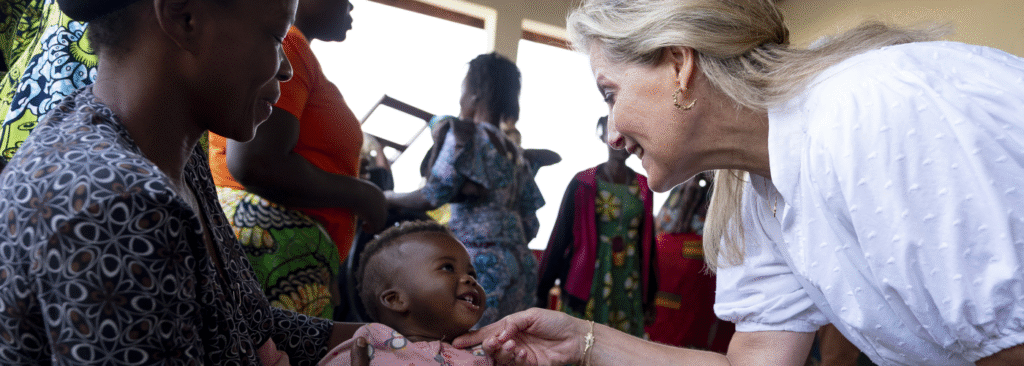
The Duchess of Edinburgh has returned to Congo — a country still drenched in grief — at the request of the UK’s Foreign, Commonwealth and Development Office. Her visit, timed to mark 25 years of the “Women, Peace and Security” agenda, brought royal grace to a place the world rarely looks at twice. From the outside, it was a noble mission of solidarity. But for those of us who live this pain, it was also a reminder: Congo is where the powerful come to witness suffering, not to end it.
The Duchess’s arrival in Beni, now a makeshift capital after the fall of Goma to the M23 rebels, came as thousands of families crowded under tarps, surviving on hope and thin porridge. She met women peacebuilders — the real heroes — who wake every day to rebuild what war tears down. She listened to mothers whose daughters were raped in the name of politics, and to survivors who carry both scars and strength. They told her of the horror that lives in their bodies, the silence that society forces on them, and the courage it takes to simply keep living.
At Beni General Hospital, she met clinicians funded by the UK government, working tirelessly to repair what violence has broken. There, she saw the quiet dignity of women who have been brutalized, abandoned, yet refuse to die. And at the UK-supported Women’s Safe Space, she sat with girls learning new skills — sewing, baking, surviving — proof that even in the ruins, life insists on returning.
The Duchess also visited Virunga National Park’s café, where conservation meets courage. The park, guarded by rangers who have died protecting both gorillas and human hope, stands as one of the few places where Congolese nature still breathes freely. Yet even here, the shadow of war lingers. Each tree, each mountain, each river is a reminder that the same land that nourishes us is the one bleeding beneath our feet.
From Beni, the Duchess flew to Kinshasa, where she met President Félix Tshisekedi and Nobel Peace Prize winner Dr. Denis Mukwege at the Panzi Hospital — a sanctuary for women whose bodies have become battlefields. Mukwege has stitched together lives that the world would rather forget. In those hospital corridors, hope and horror coexist: women waiting for surgery after mass rape, others holding babies born of violence, all carrying stories too heavy for words.
The Duchess listened to them, offered sympathy, and promised continued support. She even visited a safe house for survivors of the horrific Makala Prison incident — where, during a mass escape in 2024, hundreds of women were raped by thousands of men. It was one of the darkest moments in our nation’s modern history. Some of those survivors are still ostracized, their families calling them “shame,” their communities pretending they don’t exist.
Her Royal Highness also met legal experts and displaced professionals who now fight for justice from exile. Many of them once served in courts or NGOs in Goma and Bukavu — until M23 made justice a death sentence.
And yet, amid the photographs and handshakes, a truth must be spoken: Congo does not need more sympathy; it needs accountability. It needs the UK, and every nation that funds peacekeeping, to go beyond symbolic visits. Because the same global systems that send royals to express compassion are the ones that empower Rwanda to arm M23, and allow corporations to buy our stolen minerals.
What does it mean when foreign leaders come to comfort us, but not to confront those who cause our pain? When they fund hospitals to treat rape survivors but remain silent about the governments whose weapons made those rapes possible? When they sip coffee from Virunga while our villages burn nearby?
This visit was a gesture of grace, yes. But grace without justice is performance.
To the Duchess, we say: thank you for listening. But to the British government, we ask: will you act? Will you speak up when Rwanda violates Congo’s sovereignty? Will you sanction the companies that profit from blood minerals? Will you ensure that your “Women, Peace, and Security” agenda means something beyond photo opportunities?
Congo does not need more royal visits — it needs global honesty. It needs allies who will name the oppressor, not just embrace the oppressed.
Because every woman who told her story to the Duchess deserves more than applause. She deserves a world that stops the violence before she bleeds.
Powerful words! The writer shows what so many foreign diplomats refuse to see, that sympathy without accountability is just another way of maintaining the status quo. The Duchess’s compassion is appreciated, but it is time for the UK and other nations to stop pretending that humanitarian aid can replace justice. This article deserves to be read in every embassy in Kinshasa.
I understand the emotion, but we shouldn’t attack those who actually come to help. The Duchess is not responsible for Rwanda or for the M23. She came to show solidarity and raise awareness, and that matters. Sometimes small gestures open big doors. Soyons justes. While the article is well written, it feels unfair to expect foreign governments to solve all of Congo’s problems. The root of our crisis is internal mismanagement, not just external influence. Before blaming London or Kigali, we should also look at Kinshasa, corruption and poor leadership weaken us more than any foreign army.