TEACHERS CRY FOUL AS BANK ACCUSED OF STEALING THEIR SALARIES IN MOBA
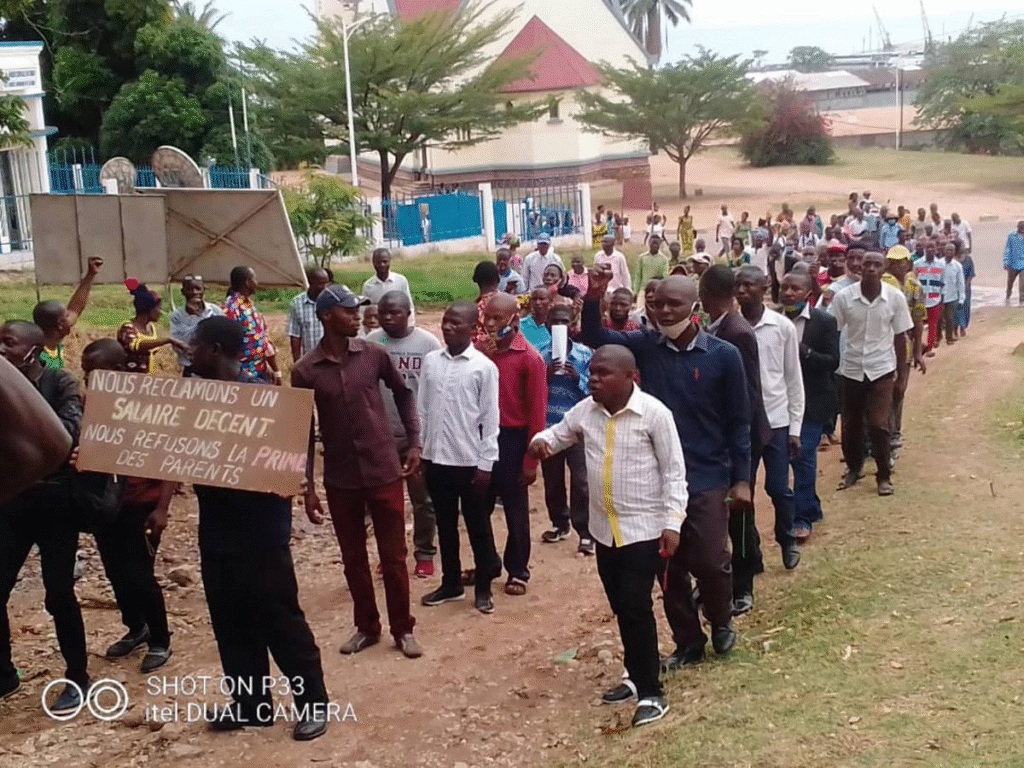
In the dusty classrooms of Moba, where teachers already survive on meagre wages and broken promises, a new betrayal has deepened the wound. The Congolese Teachers’ Union (SYECO) has accused TMB Bank of embezzling more than 77 million Congolese francs — about 27,500 US dollars — meant for teachers’ salaries over just four months.
According to a statement received by Radio Okapi on February 12, SYECO claims that since October last year, TMB and its paying agents in Moba have been quietly siphoning off portions of teachers’ pay. What began as small deductions has ballooned into what the union calls “an organized theft from the poorest servants of the nation.”
Placide Muyumba Ngoy, SYECO’s permanent secretary in Moba, detailed how the scheme allegedly works. TMB itself, he said, withholds 500 Congolese francs — around 17 cents — from each teacher’s monthly salary, while the paying agents pocket between 3,000 and 5,000 francs (roughly one to two US dollars) per person every month. The result: between 8,000 and 10,000 francs, or about $3.50, disappearing from each teacher’s pay packet every month.
It may sound small to some, but in a territory where a teacher’s salary can barely feed a family for a week, every franc counts. Over four months, these deductions amount to about 77 million francs — the equivalent of a year’s salary for dozens of teachers.
“It turns out that TMB alone took 5,411,000 francs from October 2024 to January 2025,” said Muyumba Ngoy. “The paying agents kept between 24 million and 41 million francs. This is money that belongs to teachers — money that feeds their families, pays school fees, and keeps them alive.”
TMB Bank, however, has denied all allegations. A source within the bank’s Kalemie branch told Radio Okapi that the institution “has not withdrawn any unauthorized amount” from salaries. The only deduction, the source claimed, is a standard account maintenance fee of $2.50 per month.
But for the teachers of Moba, the math doesn’t add up. Their payslips show missing amounts, and no one can explain where the money went. In a country where corruption is often invisible but always felt, the suspicion is that someone — or several someones — is profiting from their hunger.
What makes the situation worse is the silence from local authorities. Despite repeated complaints, there has been no investigation, no audit, no accountability. Teachers have begun to wonder whether the problem runs deeper — whether the system itself is built to exploit them.
“We teach the children of the nation, yet the nation robs us,” said one teacher quietly, afraid to give her name. “If even our salaries are stolen, what future are we building?”
For now, TMB continues to operate as usual, and the teachers continue to wait — for justice, for an explanation, and for the day their salaries will be theirs again, in full.