KABILA’S RETURN: THE GHOST WHO NEVER LEFT CONGO
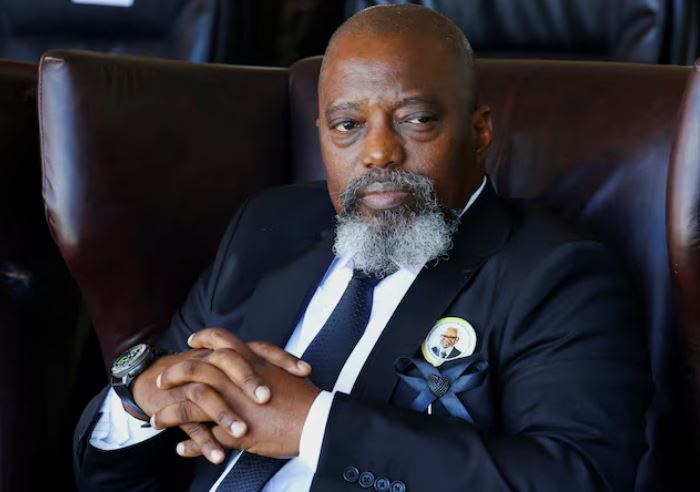
When Joseph Kabila’s plane landed in Goma on April 18, it was more than a homecoming. It was the return of a ghost — a reminder that in Congo, power never really leaves, it only hides and waits. For years, Kabila ruled in silence, and now he returns in the same way: no speech, no declaration, just his presence. But that silence is louder than any words.
He came through Rwanda — the very neighbour accused of fueling our war — and entered through Goma, the city now controlled by the Rwanda-backed M23. To the rebels, his arrival is a gift. To the government in Kinshasa, it is a nightmare. To the people of Congo, it is a wound reopened.
This is not nostalgia. This is strategy. Kabila has always thrived in shadows, mastering the art of silence and survival. The man who once ruled from behind closed doors is now standing on the balcony of the Serena Hotel in Goma, letting the world guess whose side he is on.
But one thing is clear: his return has thrown Congo into another storm. President Tshisekedi reacted with fear, suspending Kabila’s party, the PPRD, and seizing his assets. The government calls him a traitor, accusing him of helping M23. The rebels, on the other hand, welcome his presence. And once again, Congo’s fate is being shaped by men who play chess with human lives.
I do not believe in coincidences. Kabila’s return is not about visiting home — it is about power. It is about reclaiming relevance in a country he never truly left. During his exile, he was never silent. He travelled between Addis Ababa, Nairobi, and Johannesburg, meeting political figures and old allies, building something in the dark. Now, as M23 and their political arm, the Alliance Fleuve Congo (AFC), claim to fight for “liberation,” Kabila’s shadow falls perfectly over their message.
The rebels say they fight for the rights of the marginalized Swahili-speaking and Rwandophone communities, but their guns point mostly at civilians. They speak of freedom while occupying cities, looting resources, and killing the poor. Their so-called “liberation” is just another name for control. And now, with Kabila’s silent arrival, they have found legitimacy in the eyes of those who remember his rule as more stable than Tshisekedi’s chaos.
That is the danger. Because many in Katanga and the Swahili-speaking regions still see Kabila as a symbol of strength, not corruption. They remember him as the man who brought some peace after his father’s wars, who built roads and opened the mines, even as he filled his pockets. In a country exhausted by instability, people often confuse the absence of war with peace. Kabila knows this. That is why he returns now — not as a fugitive, but as a saviour in waiting.
Yet we must not forget what his rule truly was: corruption, electoral fraud, and suppression. The same man accused of stealing elections in 2006, 2011, and possibly fixing the 2018 vote to secure Tshisekedi’s rise cannot now pretend to be a victim of injustice. Kabila’s silence may seem dignified, but it is soaked in calculation. His every step is measured, every pause deliberate. He knows how to wait for power to stumble before he picks it up again.
But this time, the stakes are higher. The east of Congo is no longer just a battlefield — it is the prize of global powers. The Americans are pushing for new mineral deals to feed their industries. The Chinese, who dominated the mines under Kabila, want their control back. Private military companies are circling like vultures, ready to profit from our chaos. Even Erik Prince, the founder of Blackwater, has made deals to secure Congo’s minerals under the cover of “security reform.”
Kabila’s return adds another layer to this deadly game. To the Chinese, he is a familiar partner. To the Americans, a potential spoiler. To Rwanda, a possible ally. To Tshisekedi, a rival who refuses to stay buried. And to the people, he is both memory and mystery — the ghost who might rise again.
But if he aligns himself too closely with the M23, he risks lighting a match in a room already soaked with gasoline. Ethnic tensions are growing. Rumours say communities are arming themselves, preparing for revenge. The Southern African Development Community (SADC) forces are pulling out. If the state collapses, it will not be politicians or generals who die first. It will be the poor — as always.
Kabila’s return is not a symbol of hope. It is a warning. Congo is once again standing at the edge of disaster, with too many men chasing power and too few fighting for peace.
The ghosts of our past keep returning because our leaders refuse to bury them with truth and justice. Until that happens, Congo will remain trapped in a cycle where yesterday’s rulers become tomorrow’s rebels, and the people keep paying the price.
Kabila may believe he can rewrite his legacy. But history is watching. And so are we.